How to Build an Entrepreneur Community That People Actually Want to Be In
- Deevo Tindall
- May 27
- 6 min read
Prepared for The Brand Lab with Deevo · 2026
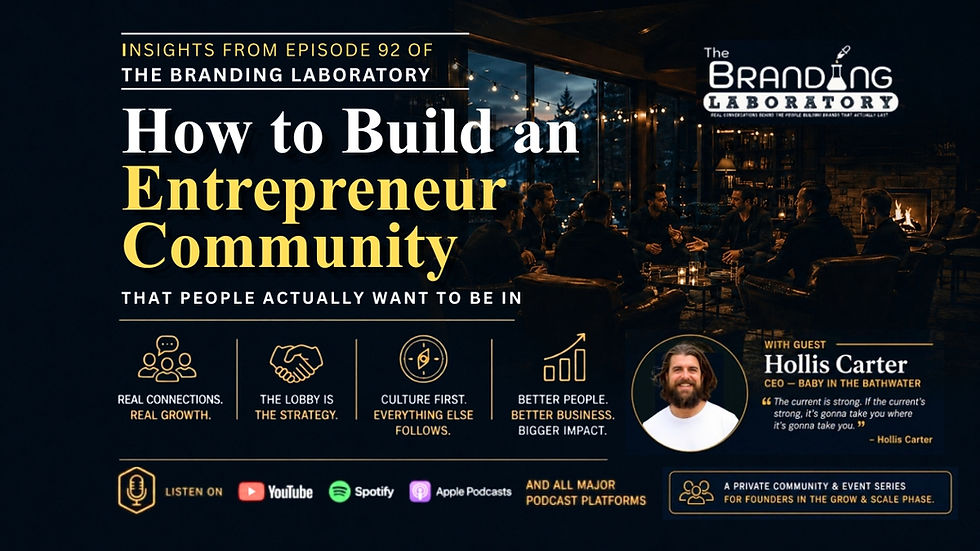
Most entrepreneur communities are built around content. Speakers. Slides. Frameworks delivered from a stage under fluorescent lights. And most of them fall flat for the same reason: the content was never what people came for.
Hollis Carter figured this out after spending a decade and a fortune attending conferences, masterminds, and business events. The breakthrough moments happened after the sessions. They happened in the lobby, between strangers who turned into collaborators, partners, and friends.
So he built something different. Baby in the Bathwater is a private membership community and event series for founders in the grow-and-scale phase. No sponsors. No sales pitches. No keynotes you could watch on YouTube anyway. Just carefully curated people, in a beautiful setting, with the lobby as the main event. A decade in, the waitlist is long, the events sell out, and the culture has taken on a life of its own.
In a recent conversation on The Branding Laboratory, Hollis walked me through exactly how it happened, and what it taught him about leadership, personal values, and building a business that makes you want to skip the alarm clock.
The Problem With Most Networking (And Why the Lobby Was Always the Answer)
Hollis spent years paying for events where the real value had nothing to do with what was on the agenda. Over time, a pattern became undeniable: the conversations that changed his business happened in corridors, at hotel bars, and on shuttle rides to the venue.
His goal at every event was simple. Meet one person who could be a genuine peer, someone who could challenge him, support him, and receive the same in return. Someone who understood what it felt like to not know what your phone would bring when you opened it in the morning.
"It was almost always a partnership or a connection that was made that caused the hockey stick to happen, not grinding out 1,000 hours on something." — Hollis Carter
When he and his co-founder decided to build something, the question was straightforward: what if the lobby was the whole point? What if you stripped away everything else and just built the conditions for those conversations to happen reliably, with people who had already earned their seat?
Building Culture Before Building a Business
Baby in the Bathwater did not launch with a pitch deck or a target market. The first event was an invitation to the people Hollis had met in lobbies over ten years. Come together, see what happens. No sponsors, no sales pitches, and every attendee on the same housing and meals package regardless of their status or following.
That last detail mattered more than it sounds. Hollis spent a year personally calling high-profile speakers who were used to VIP treatment at other events and asking them to pay to attend, so they could be around peers instead of performing for an audience. The democratized format sent a clear signal: everyone here has something to offer, and no one knows everything.
"The current is strong. If the current's strong, it's gonna take you where it's gonna take you." — Hollis Carter
The early years required careful curation. Hollis made mistakes, let the wrong people in, and once refunded a well-known guest mid-event to then asked them to leave the next morning. The work paid off. A decade later, the community culture is so established that it largely self-corrects. New members get absorbed into a current that was built over years.
The Three Levels of Community Participation
Not everyone shows up to a community with the same intention, and Hollis has spent years learning to identify the difference. He describes three distinct levels of participation that he watches for in prospective members.
The first level is transactional. These are people who come to get clients, sell services, or extract value. Plenty of communities exist for them, and they serve a purpose.
The second level involves people who share and add value, but with a visible motivation. The giving is real, but it's tied to an expectation of reciprocity.
The third level is what Hollis calls competitive giving. These are people who help when they can, regardless of whether there's something in it for them. They have enough faith in the long game that they don't need every interaction to be an exchange.
"The wins that they get back are even so much bigger, but sometimes they're on a longer time horizon. It's almost like a karmatic kind of faith in oneself." — Hollis Carter
Attracting third-level participants is Baby in the Bathwater's primary mission. And while most founders have to go through the first two stages before they reach the third, Hollis says the ones who get there early tend to see their results compound faster, because they're less shortsighted.
Why the Process Is the Point (And Early Success Can Be a Trap)
Hollis built a ski-in, ski-out house in his late twenties. He leveraged aggressively to get what he thought was the dream: the retirement-era payoff, decades ahead of schedule. And when he finally moved in, he realized he didn't actually want it.
The experience became one of his clearest lessons about the relationship between success and readiness. Getting to a destination before you've developed the capacity to hold it doesn't work. He's watched it happen to other founders too. Early exits, fast success, and then self-sabotage, because the experience base that should have supported the win was never built.
"There's no shortcut. It's all dual in my mind. You can't have the good without the bad. You can't have the results without the time." — Hollis Carter
The same logic applies to working on yourself as a person. Hollis talks about Jim Rohn's principle, work on yourself more than you work on your business, and the business will take care of itself, as one of the few frameworks that genuinely compounded for him. Not as a productivity tactic, but as a prerequisite for showing up well for everyone else.
What Leadership Actually Looks Like at This Stage
When I asked Hollis to define leadership, he pushed back on the idea that there's a single clean answer. Leadership looks different depending on what you're leading, a team, a community, a family, or yourself on a hard day when the easier option is to hit snooze.
His working definition centers on knowing where your own strengths are, knowing where other people's strengths are, and building the conditions for them to come together effectively. The practical tip he keeps returning to: speak last in meetings. If you know the answer to something that comes up, wait. See if someone else gets there. Refine rather than direct. The best leaders, he says, almost don't need to be seen as leaders at all.
"You have to be willing to let them fodder and get to the point of it. You have to be patient in order to do that." — Hollis Carter
He also draws a clear line between collaborative leadership and self-sacrifice. You cannot be useful to others if you're running on empty. His personal framework for the year: sturdy, leverage, and systems. Three words that reflect a founder who has learned to build for longevity rather than sprinting toward the next thing.
Key Takeaways
Build culture before you build your business model. Baby in the Bathwater ran for years without a defined niche because culture came first.
The people who help without an agenda tend to win bigger. Competitive giving is a long-game strategy that compounds in ways transactional networking cannot.
Early success without earned experience is a liability. The process builds the capacity to hold the result.
Leaders who speak last often lead better. Creating space for others to be right is a form of strength, not abdication.
Working on yourself is not optional once you're leading others. Your capacity to show up determines everything downstream.
Bettering before biggering: if you can't do it better than last time, it might not be worth doing again.
About Hollis Carter
Hollis Carter is a serial entrepreneur who has been building businesses since he was 12 years old. He has bootstrapped companies in landscaping, affiliate marketing, software, and publishing, and has spent a decade co-running Baby in the Bathwater, a private membership community and event series for founders who are in the grow-and-scale phase of their business. Baby in the Bathwater operates on a referral-only, application basis and is designed specifically to manufacture the kind of serendipitous connections that typically happen only by accident.
Learn more at https://babybathwater.com/
Listen to the Full Episode
This conversation is packed with the kind of specifics that don't compress well into a summary. Hollis gets into the details of his onboarding process, the mistakes he made curation in the early years, and what his personal core values look like in practice, including one about never saying nice things about people behind their backs without telling them directly.
🎧 LISTEN NOW
The Branding Laboratory with Deevo → thebrandstoryteller.com


Comments