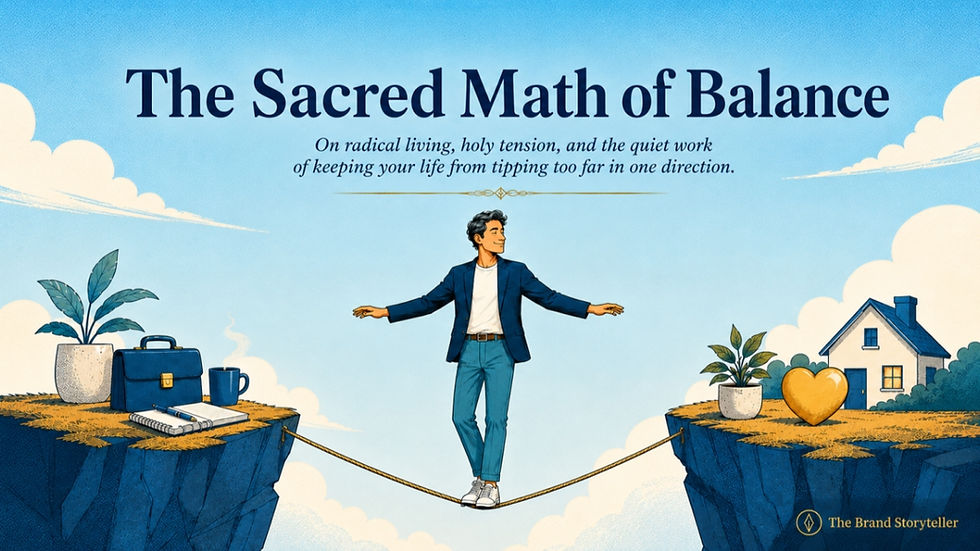
The Sacred Math of Balance
On radical living, holy tension, and the quiet work of keeping your life from tipping too far in one direction
I had a conversation recently with a new friend I deeply respect, a man named Troy Williams whose ideas make you sit up a little straighter because you can tell there is actual thought behind them, which is always refreshing in a world where most opinions arrive pre-chewed by an algorithm and emotionally seasoned by whatever childhood wound happens to be trending that week.
Troy has the particular gift of asking questions that refuse to leave you alone after the room has emptied, and this essay is the direct result of one of them. Troy, thank you for the friendship, the friction, and for being exactly the kind of thinker who makes everyone around you sharper just by showing up honestly…
We were talking about balance.
His take was that balance does not really exist, and that human beings are designed to be “radical”. I understood what he meant because radicality has an undeniable pulse to it, it feels alive and brave and hot-blooded and considerably more interesting than “reasonable integration”, which sounds like a breakout session at a corporate retreat right before someone hands you a branded water bottle and asks you to share one fun fact about yourself (“I’m one of 12 siblings…”) in a circle of people who all wish they were somewhere else.
There is something in us that wants to burn, build, love, risk, create, surrender, and throw the whole body into whatever feels true enough to rearrange our lives around it, and I respect that impulse because I have lived enough of it to know both the beauty and the wreckage it leaves behind.
Still, I keep coming back to balance and I think I know why now.
I grew up without much of it around me. My nervous system learned early how to scan the room, adapt quickly, and stay ready for whatever might arrive next, which is a useful skill when life feels unpredictable and a very expensive one when it quietly becomes the operating system for adulthood and starts running in the background of every relationship, every decision, and every moment that was supposed to feel like rest but somehow feels like a tactical pause between threats.
So when I talk about balance, I am talking about something considerably deeper than lifestyle management or the wellness industry's favorite word for doing slightly less of everything while buying slightly more supplements.
I am talking about the long slow work of teaching a body shaped by intensity, that peace is allowed, that steadiness is safe, and that life does not have to stay organized around survival forever.
That is why balance keeps pulling me back toward the same questions, and why those questions keep showing up in the real places where life either works or starts quietly coming apart.
Balance Has a Branding Problem
The word has been dragged through the beige hallways of corporate wellness culture and returned to us holding a green juice, whispering about peace, and somehow managing to avoid the very real fact that someone still has to pay the mortgage, raise the children, answer the email, have the hard conversation, take care of the body, and figure out why the relationship now feels like two exhausted project managers arguing over invisible labor while calling it partnership.
So I understand the eye roll. The word can feel too soft, too polite, too domesticated, and too close to something printed on a yoga studio wall next to a succulent that gave up emotionally in 2019 and has simply been performing survival ever since.
Real balance deserves a better argument…
Here is the best definition I have arrived at after more living than I sometimes care to account for…balance is the intelligent distribution of intensity.
It gives fire somewhere useful to burn. It gives ambition a relationship to the rest of your life. It gives love enough room to breathe without turning into possession. It gives discipline a body to serve rather than a body to conquer. It keeps the strongest part of you from becoming the only part of you that is allowed to speak, which is a problem that masquerades as virtue for an impressively long time before the cost of it shows up somewhere you cannot ignore.
Extremes feel clarifying because they allow us to become one thing loudly enough to avoid the more difficult work of becoming whole.
The ambitious person hides inside productivity. The spiritual person hides inside transcendence. The deeply religious person hides inside doctrine, finding considerable comfort in a system where the questions were pre-answered, dissent is rebranded as faithlessness, and God conveniently agrees with everything the group already believes. The disciplined person hides inside control with a very clean calendar and a faint ambient smell of superiority.
Balance interrupts all of those performances by asking the one question they are all designed to avoid, which is whether the thing we are calling devotion has slowly and quietly become a tyrant.
We Always Know When It Has Left the Room
The question I keep returning to is simple enough to irritate me, which tells me it’s a reliable sign that it is worth asking.
If balance is imaginary, why do we recognize its absence so immediately and so viscerally?
We feel it in the parent who provides everything except presence. In the partner who wants intimacy but arrives home already hollowed out, the glowing rectangle of modern doom having eaten most of what was left on the commute.
We feel it in the high performer who keeps calling exhaustion responsibility, because responsibility sounds nobler than collapse and photographs considerably better on LinkedIn.
A body knows imbalance before the mind has built the case for it, the heart feels when connection has gone thin, the home registers when laughter has been replaced by logistics, the relationship knows when repair has become management, and the work knows when it has stopped being a contribution and started being a hiding place.
That is the most compelling argument for balance I know. Even when we cannot define it with precision, we know when it has left the room, and we know it the way we know when a conversation has shifted and the air has changed and something real has been replaced by something merely functional.
The Real Threat Is Possession
The word I keep circling is possession, and I mean it in the oldest sense of the word.
Imbalance happens when one part of us takes over and starts speaking for the whole life, and the takeover is rarely dramatic enough to notice in real time. Ambition moves in quietly and relationships start feeling like interruptions to the real work rather than the point of it. Fear gets comfortable and suddenly every open door has a catch worth investigating before you touch the handle. Control tightens its grip and mystery becomes intolerable, spontaneity becomes a risk assessment, and the people closest to you start feeling managed rather than loved. And when pain is running the show, every person in your orbit becomes a witness, a rescuer, a prosecutor, or a defendant in a trial nobody else knows is happening, which is an exhausting court to keep in session and an even more exhausting one to be summoned to without warning.
A life goes out of balance when one part of the self starts making executive decisions while the rest of the person waits outside the conference room, hoping someone remembers that the meeting was supposed to be about the whole damn life.
This is why balance feels less like moderation and more like a form of internal leadership, the ability to notice which part of you has taken the wheel, hear what it is trying to protect, and bring the rest of your life back into the room before the loudest part starts running the whole company with the confidence of a man who listened to half a podcast and now has a framework and a newsletter… I am not talking about me… ahem.
Most of us have a dominant pattern that sounds extremely convincing because it has kept us alive, successful, chosen, or emotionally unavailable enough to survive the previous chapter, and that pattern has a voice that is very persuasive at three in the morning, telling us that more is necessary, that quiet is safety, that trust is a liability, and that the current arrangement, however quietly exhausting, is simply how things are now.
Balance is the art of becoming the mature voice inside yourself, the one that can hear all of those parts without being run by any of them, which is genuinely annoying because maturity rarely arrives as a spiritual revelation. Most of the time it arrives as one honest adjustment you have been avoiding because the old pattern still has a very convincing legal team and an excellent record of keeping you functional in ways that are technically impressive and privately exhausting.
The Old Wisdom Knew This
Every wisdom tradition that has survived long enough to be taken seriously has been circling this same territory in its own language, symbols, robes, and occasional parables that make you wonder whether enlightenment has always required fewer browser tabs open in the soul.
The Buddha's Middle Way is often treated like a polite spiritual middle lane, but the deeper teaching is considerably more demanding than that. It came from the lived recognition that both indulgence and deprivation can become elaborate ways of avoiding waking up, which is a rude observation that applies to significantly more of modern life than most of us are comfortable admitting before noon.
Alan Watts had the same idea about muddy water becoming clear when left alone, which is deeply offensive to the part of us that wants to poke every problem until it produces an answer on our timeline (guilty as charged). Sometimes the water is muddy because we keep stirring it. Sometimes the effort is the very thing preventing the clarity from settling, which is a teaching that lands differently depending on how many things you have on your to do list right now.
The older wisdom underneath all of it points toward rhythm. Breath in and breath out. Effort and recovery. Speech and silence. Solitude and connection. Even the natural world seems to understand what modern human beings keep forgetting while attempting to live like battery-powered gods with calendar invites and no maintenance plan.
Balance Is Calibration
The practical truth is that balance is not a destination you arrive at and unpack your bags. It is a continuous calibration, because life keeps changing shape and the calibration required at thirty-five is different from what forty-five demands, and what the season of building requires is different from what the season of sustaining needs, and what the body requires after years of ignoring it is different from what it needed when you were still young enough to get away with the ignoring.
There are seasons where work needs more. Seasons where children need more. Seasons where the body finally demands attention because it has been quietly taking notes for years and would now like to speak to management (been there did that)...
Seasons where love needs more presence than you have been giving it, and seasons where solitude needs more protection than you have been affording it, and seasons where the thing you have been calling productivity has been functioning primarily as a very sophisticated avoidance strategy with excellent output metrics.
Balance means everything gets honest consideration, and honest consideration means asking the questions that the dominant part of you would rather not answer.
Where is my life loudest right now, and is that loudness serving something real or consuming something essential?
Where have I started calling the imbalance necessary because admitting the excess would require a decision I have been postponing?
What have I neglected long enough that it now speaks through resentment or fatigue or distance or that charming little eye twitch I keep blaming on caffeine as though caffeine has retained legal counsel and is prepared to defend itself?
Then make one honest adjustment… notice I did not say a reinvention friend... nor did I say a twelve-step plan or a new morning routine involving imported moss and a gong (although I could align with the gong) and the kind of discipline that photographs beautifully and lasts approximately eleven days.
One adjustment that brings the system back toward truth, because the solutions are usually simple enough to dismiss and important enough to change the entire emotional temperature of your life when you finally stop dismissing them.
What I Actually Believe
I understand the argument that we are designed to be radical because there is something undeniably human about wanting to live with fire. I want that life too.
I want to love deeply, build bravely, create with genuine abandon, and show up fully awake to the strange brief miracle of being here for a little while with a body, a story, a handful of people worth loving, and no real instruction manual beyond the occasional ancient text and whatever my nervous system is trying to communicate before I make it drink another coffee.
I just want the fire held inside something conscious enough to keep it from consuming the house.
Passion becomes compulsion when it loses proportion, discipline becomes punishment when it loses tenderness, love becomes possession when it loses freedom, and ambition becomes a god with terrible boundaries when it forgets it was always meant to serve the life rather than consume it. Balance is what gives all of those forces a place to belong, a hearth rather than a throne, so that the fire stays useful and the house stays standing and the people inside it still recognize each other at the end of the day.
It gives fire a hearth, intensity a rhythm, and the strongest part of you a context rather than a throne.
And maybe that is the deeper conversation my friend and I were actually having… not whether balance exists, but whether we are brave enough to want it, because radicality is easier to romanticize than integration, and integration is harder than extremism because it asks you to keep adjusting, keep listening, keep bringing the whole life back into the room, indefinitely, without the clean simplicity of just becoming one thing loudly and calling it identity.
The most radical thing I know how to do right now is learn how to hold the fire without becoming it.
That feels like the kind of radical worth spending a life on.
If this landed somewhere real, reply and tell me what it stirred up. That conversation is always worth having.
Deevo The Brand Storyteller [thebrandstoryteller.com]
About Deevo
Deevo is a brand strategist, identity architect, and founder of The Brand Storyteller. His work sits at the intersection of psychology, narrative, and strategic clarity, helping founders and executives figure out what they are actually building, who it is actually for, and why so much of their effort feels like it should be compounding faster than it does. He works privately with a small number of people at a time, which is either very intentional or very antisocial depending on who you ask. He does not call himself a coach. If you have read this far, you already know why.
Comments